Sometimes, it can be difficult to explain to people why we would leave our fabulous lives in Seattle and move to a country we knew nothing about and had to look at a map to remember where it was located. Often, I'm not very articulate about it, but Joel over at Why Paraguay is. This article reflecting on his family's first year here highlights the great and not so great parts of Paraguay!
Tuesday, August 26, 2014
Friday, August 22, 2014
Some Photos From Our Recent Trips Into The Campo
We have taken three consecutive weekend trips out of Asuncion. Living in the city is convenient, but it would be fairly miserable if we were not able to venture out into the countryside.
Three weeks ago our friend Fede took us to his family's ranch. Due to flooding you can not presently drive to their house. Getting to his property required traveling first by truck, then by boat, and finally by tractor.
| Horses on the property |
| An old church on the property |
We spent the rest of the afternoon looking for a hotel, hanging out by the river and having an obligatory meal of fish soup and milenesa.
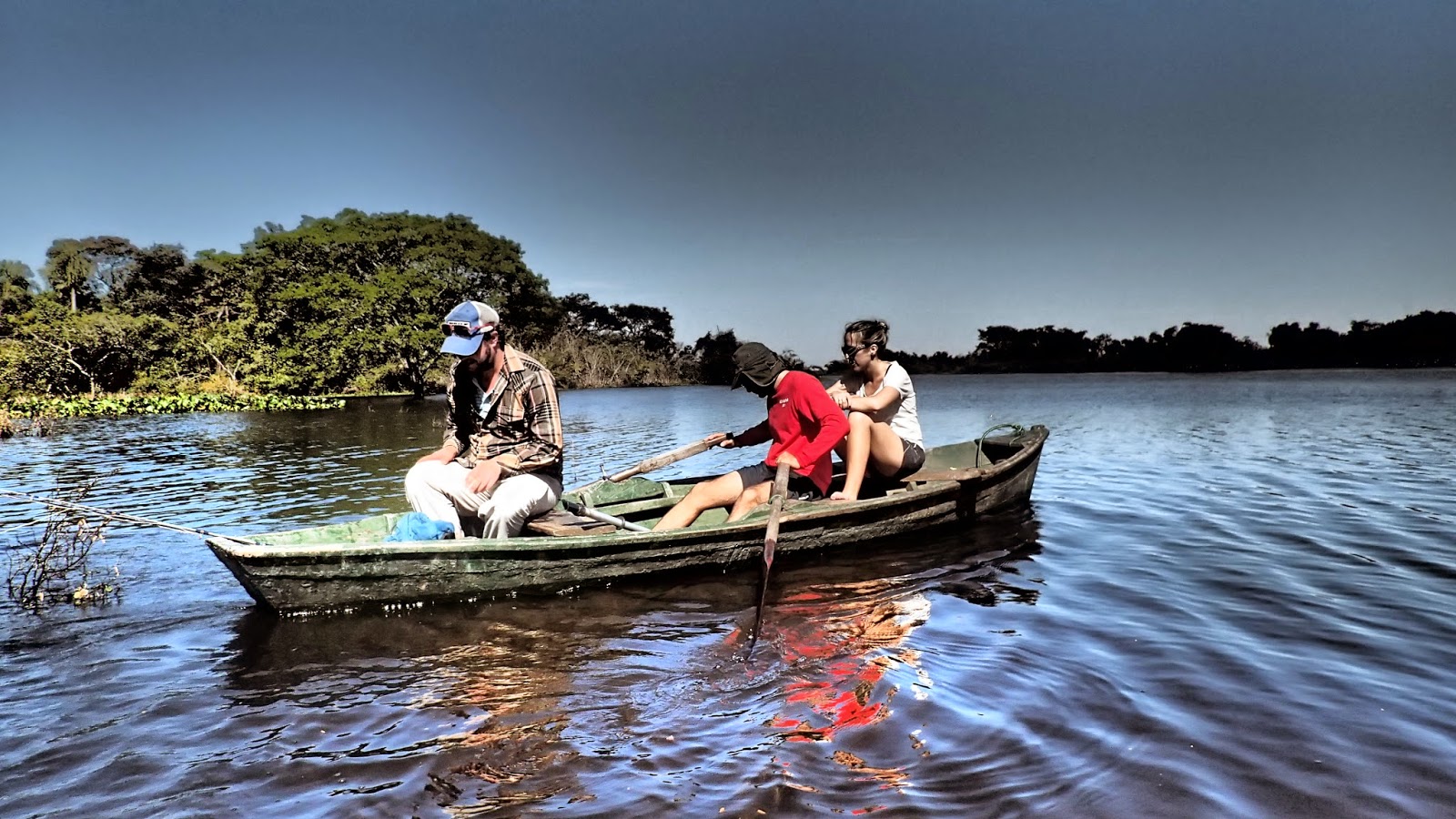
The next day Will found a local guy to take us fishing in a flooded bay next to town. We caught some little catfish called manda-i, piranhas, and another little fish called a mojarrita.
Will had not been fishing in years, but he is a master at throwing a hand line.
Rob unhooking his mojarrita.
We grilled up a few of the fish. The manda-i was really good. The piranhas were good also, but hard to eat because the they have many small pointy bones.
Last weekend a group of teachers took a trip to an area we had been wanting to visit for a while. Tres Kandu: or Three Humps.
It was our first backpacking trip in Paraguay and we ascended Paraguay's tallest peak, all 842 meters of it. Although it was a short hike, the trail was fairly steep and most of us were sore for a couple days afterwards.
Above our friend Ali diligently starts a fire with out the use of accelerants and Will prepares to spread some snake repellent around the perimeter of our camp. This Paraguayan outdoor trick is called "Fluido Manchester" and is actually an automotive lubricant that smells awful, apparently snakes hate it.
Labels:
Camping,
fishing,
Paraguay,
river trip,
travel,
tres kandu,
villa florida paraguay
Location:
Cerro 3 KandĂș, Paraguay
Thursday, August 21, 2014
Spring time in Paraguay
The summer (and most of the year really) can be brutally hot, but Spring in Paraguay is a lovely time. The weather is in the 80's, it's sunny, and there are beautiful flowers in bloom. Here are a few from my walk to school!
Monday, August 11, 2014
Year 2 begins!
We've passed our year milestone in Paraguay and the start of year 2 has been full of big changes. We have moved into a large house with 4 other teachers from my school. The house is fantastic-we have a pool, a great backyard with a patio that has a grill and a brick oven, a huge bedroom with our own balcony and bathroom, and possibly the best thing of all is our full time maid, Natalia. It's nice to live in a place again where we can do one of my favorite things-entertain and cook for people. It is certainly an adjustment to live with other people again, but so far it's been really fun to have friends at home to hang out with after work.
Another big change is that I've moved to teaching 7th and 8th grade Social Studies. I have wanted to teach SS for a long time, but since all of my experience is in Language Arts, it's been hard to get a job. I'm teaching World History and U.S history, two subjects which can be a lot of fun. I struggled with the adjustment to teaching privileged kids last year, but now that I have some experience to lean on, I'm finding the job a little easier and more rewarding. I'm having a blast teaching Social Studies, although it's a lot more work, as I'm planning everything from scratch since it's my first time. Now that I have the hang of teaching at the school, I feel more confident experimenting with new ideas in the classroom and trying things that I would never have been able to do in a struggling school like where I worked in Seattle.
The school is also undergoing many changes, including 15 new teachers and 3 new administrators. I have a new principal, who has moved to Paraguay from China, but has also lived in Nicaragua. He's a fantastic addition to the school and I'm really looking forward to the rest of the school year. The second semester last year was difficult for me as a professional, but I have a feeling things have really turned around and I am feeling positive and recharged as an educator.
We are of course plotting several upcoming travel adventures including climbing the tallest mountain in Paraguay (3,000 feet!) and visiting a nature preserve in the South of the country. We are both looking forward to the many adventures our second year in this beautiful and sometimes baffling country we call home!
Wednesday, July 30, 2014
Salta Argentina
Kristi and I had planned to take my parents to Salta during their visit in our car, but circumstances conspired against us and we traveled with them in Paraguay instead. After they departed we left for Salta by bus. We were still able to take advantage of a fairly posh Air B&B reservation my parents had made. Our hosts generously moved our reservation dates and upon our arrival even invited us into their home to watch Brazil play the Netherlands.
The city of Salta itself was perfectly pleasant. Similar in many respects to other Argentinian cities the central area featured: plazas, old churches, parks, street vendors, a mediocre lager style beer named after the city and all manner of shopping. Salta also has a very impressive anthropological museum featuring Andean mummies, artifacts, and really good interpretative info in both Spanish and English.
The Northern provinces do feature some things not found in other areas of Argentina. The municipal market had a few things we were not used to seeing like these amazing potatoes and coca leaf. Some people suggested the area was in some ways more similar to Bolivia than other parts of Argentina and when we left the city this seemed especially true.
The most exciting difference we encountered were these tamales which we ate on a daily basis and we found to be as enjoyable as any Mexican or Central American Tamales we could remember eating. Another regional dish we sampled was called locro and featured corn, squash, beans, and a variety of savory meat pieces. Both dishes were a pleasant departure from the Argentinean pizza, sandwiches, and pastas that are frequently disappointing.
We spent our first couple days doing stuff around Salta including including watching the World Cup final. We were excited to be in Argentina for the final but not especially sure how the people would react to a possible loss. The people we were with cheered for their team all game and after the match stood, applauded and said
"second place is good."
We then took a very long day trip to visit two mountain towns called Purmamarca and Tilcara,
We left the forest and emerged into an otherworldly landscape of multi-colored rock formations and very little vegetation. Our pictures do not convey the stark beauty. We have never been to Moab but have read that this part of Argentina looks similar.
The towns we passed were tucked beautifully into the hillsides. Many of the buildings were simple adobe structures in various states of disrepair.
It is the middle of winter, but the intense high elevation sun, thin air, wind, and freezing evening temperatures made the places we visited feel barely hospitable.
| Cemetery near Tilcara |
From Purmamarca we drove up a pass to about 13,000 feet and then down towards the Salinas Grandes salt flat. Along the way we saw these vicunas as well as a couple of alpacas, two of the area's native camelid species.
We spent a couple hours at the salt flat and then made the long drive back to Salta.
We left Salta and drove South towards the town of Cafayate. Once again we were in a high desert like environment surrounded by incredible multi-colored rock formations. Undoubtedly the best part of this trip was the scenery we experienced driving from place to place.
If scenery was the best part of our travels, drinking some great wine was easily second best. A few bodegas we stopped at were large establishments like you might find in Mendoza. Others were tiny family run operations hidden down long dirt roads.
The most common grapes grown in the Cafeyate region were: Cab, Malbec, Tannet, and Torrontes. We usually gravitate towards Cab but the great thing about going to wine country is you try things you otherwise wouldn't. We found one tannet that we loved, as well as some Torrontes that was great during the heat of the day.
From Cafeyate we drove to the small mountain town of Cachi. Soon after leaving Cafeyate the road turned to dirt and we had another four hours of breathtaking views.
| Parrots posing roadside in route to Cachi |
| Remnants of an old church in route to Cachi |
We had a quiet night in Cachi and then got up early to make the most of one last amazing drive back to Salta. The first leg took us through an extensive cactus forest and a number of low lying fog banks. The temperature outside, according to our car thermometer, was right around freezing.
Location:
Salta, Salta Province, Argentina
Saturday, July 26, 2014
A visit from my parents 2: Paraguayan Pantanal, Piribebuy
Upon returning from our little road trip we planned to take a military transport flight to Northern Paraguay and visit the Pantanal. However, there was not space for us on the plane and that part of our trip was delayed for a couple days.
With our extra time we spent one day in the city. We visited Mercado 4, the main municipal market and went downtown to watch the US lose to Belgium. Kristi ordered a Stella (originally from Belgium), which explains why we lost. I tried to rectify things with a liter of Budweiser, but some mistakes once made...
The next day we took a trip to do some bird watching in the countryside North of the city and drove around on some back roads near the town of Cerrito. My parents saw some birds they were excited about. "Bird watching" is something Kristi and I do often when we are in the rural areas. Usually it consists of driving slowly on random dirt roads and stopping occasionally to investigate anything of interest. Paraguay has very interesting bird life, but we often spend an equal amount of time discussing the cows and chickens that roam freely everywhere through the country. They are oddly intriguing and easier to take pictures of than birds are.
On the way back to town we stopped at the fish shacks, a great area to visit, buy local fish, or eat a delicious fish based meal. We had not been here in several months. A restaurant that usually overlooks the river from a high cement bulkhead served us a great meal. The remaining restaurants and fish market were under 5 meters of water.
The following day we were able to get on the plane to Bahia Negra, a medium sized town in the Northeast corner of Paraguay very close to the border with Brazil and Bolivia.
The plane ride itself was a major part of the adventure. Until we were seated in the plane, which held about 20 people, none of us were sure if we would really be going. As far as we could tell, this plane that flies three times a week,and exists mainly to serve several small communities that are accessible seasonally by a 24 hour bus ride, or year round via a five day up river boat ride. On the way back we even made an unscheduled stop in Concepcion so one local resident could visit the doctor.
In Bahia Negra we bought some food at a small grocery and had an obligatory millenasa lunch. We then got in a small boat for our final destination: the Tres Gigantes Biological Station. (click here for more info)
The Pantanal is the world's largest tropical wetland, only a small part of which exists within Paraguay. Tres Gigantes is managed by Guyra, a non-profit conservation organization. The biological station was created to facilitate scientific studies but allows tourists to use their facilities or camp for a modest fee.
My mom told me she experienced the best bird watching she has had in thirty years. Indeed we saw many incredible birds that we had not seen in Paraguay before, as well as many other types of wildlife. In non protected areas of the country most wild animals get asadoed (cooked), so terrestrial wildlife sightings are rare. The abundance of animals we saw at Tres Gigantes made the place feel truly wild. The ranger who hosted us even showed us a picture of a Jaguar a nearby game camera had caught three days prior.
Kristi and I spent much of our time exploring the area by canoe. The reserve has a system of hiking trails. Flooding has inundated much of the land in the Pantanal this year, and in fact, the two buildings that comprise the reserve structures are currently on an island; one that has grown increasingly smaller throughout the winter. We had a great time paddling the trails, occasionally getting out to pull the boat through shallow water.
After returning to Asuncion we had planned to conclude my parents visit by driving to Salta, Argentina. However, we were expecting a critical piece of paperwork (required to drive into Argentina) to arrive while we had been in the Pantanal. Due to unknown mystical and incredibly frustrating factors of all things bureaucratic in Paraguay, our document was still being processed. We went instead to spend two nights in the countryside two hours east of Asuncion. The little burrowing owl above was a popular fixture at the place we stayed and posed for us every time we came by.
We did a good amount of relaxing at our place of lodging. The image to the right is one panel from a mural in the town of Piribebuy near where we were staying. The town was pleasant and typical of small Paraguayan towns. Historically, it is famous for a battle that took place in the town during the Triple Alliance War. The mural above depicts the towns inhabitants, many of them children, trying to fight off alliance forces. According to Wikipedia (and possibly other sources) it was a gruesome affair during which the towns hospital was burned down with the wounded inside and many prisoners were beheaded.
We also sought out a totem we had heard about located near the town of Caacupe. The totem depicts the seven Mitos, mythical monsters from Guarani mythology. Each one governs some part of life and has an entertaining back story. Jasy Jatere, for example, governs the yerba plant as well as the siesta. He is commonly known to go after children who will not take a nap when they are told to.
After our impromptu trip to the campo we returned once again to the city and my parents boarded their overnight bus to Buenos Aries
It was fantastic to have my parents spend some time with us in Paraguay and we genuinely appreciate their visit. Paraguay is not a popular tourism destination. However, with a good attitude and sense of humor it is definitely possible to have a great time traveling here, and we did just that.
With our extra time we spent one day in the city. We visited Mercado 4, the main municipal market and went downtown to watch the US lose to Belgium. Kristi ordered a Stella (originally from Belgium), which explains why we lost. I tried to rectify things with a liter of Budweiser, but some mistakes once made...
The next day we took a trip to do some bird watching in the countryside North of the city and drove around on some back roads near the town of Cerrito. My parents saw some birds they were excited about. "Bird watching" is something Kristi and I do often when we are in the rural areas. Usually it consists of driving slowly on random dirt roads and stopping occasionally to investigate anything of interest. Paraguay has very interesting bird life, but we often spend an equal amount of time discussing the cows and chickens that roam freely everywhere through the country. They are oddly intriguing and easier to take pictures of than birds are.
On the way back to town we stopped at the fish shacks, a great area to visit, buy local fish, or eat a delicious fish based meal. We had not been here in several months. A restaurant that usually overlooks the river from a high cement bulkhead served us a great meal. The remaining restaurants and fish market were under 5 meters of water.
The following day we were able to get on the plane to Bahia Negra, a medium sized town in the Northeast corner of Paraguay very close to the border with Brazil and Bolivia.
The plane ride itself was a major part of the adventure. Until we were seated in the plane, which held about 20 people, none of us were sure if we would really be going. As far as we could tell, this plane that flies three times a week,and exists mainly to serve several small communities that are accessible seasonally by a 24 hour bus ride, or year round via a five day up river boat ride. On the way back we even made an unscheduled stop in Concepcion so one local resident could visit the doctor.
In Bahia Negra we bought some food at a small grocery and had an obligatory millenasa lunch. We then got in a small boat for our final destination: the Tres Gigantes Biological Station. (click here for more info)
The Pantanal is the world's largest tropical wetland, only a small part of which exists within Paraguay. Tres Gigantes is managed by Guyra, a non-profit conservation organization. The biological station was created to facilitate scientific studies but allows tourists to use their facilities or camp for a modest fee.
My mom told me she experienced the best bird watching she has had in thirty years. Indeed we saw many incredible birds that we had not seen in Paraguay before, as well as many other types of wildlife. In non protected areas of the country most wild animals get asadoed (cooked), so terrestrial wildlife sightings are rare. The abundance of animals we saw at Tres Gigantes made the place feel truly wild. The ranger who hosted us even showed us a picture of a Jaguar a nearby game camera had caught three days prior.
Kristi and I spent much of our time exploring the area by canoe. The reserve has a system of hiking trails. Flooding has inundated much of the land in the Pantanal this year, and in fact, the two buildings that comprise the reserve structures are currently on an island; one that has grown increasingly smaller throughout the winter. We had a great time paddling the trails, occasionally getting out to pull the boat through shallow water.
After returning to Asuncion we had planned to conclude my parents visit by driving to Salta, Argentina. However, we were expecting a critical piece of paperwork (required to drive into Argentina) to arrive while we had been in the Pantanal. Due to unknown mystical and incredibly frustrating factors of all things bureaucratic in Paraguay, our document was still being processed. We went instead to spend two nights in the countryside two hours east of Asuncion. The little burrowing owl above was a popular fixture at the place we stayed and posed for us every time we came by.
We did a good amount of relaxing at our place of lodging. The image to the right is one panel from a mural in the town of Piribebuy near where we were staying. The town was pleasant and typical of small Paraguayan towns. Historically, it is famous for a battle that took place in the town during the Triple Alliance War. The mural above depicts the towns inhabitants, many of them children, trying to fight off alliance forces. According to Wikipedia (and possibly other sources) it was a gruesome affair during which the towns hospital was burned down with the wounded inside and many prisoners were beheaded.
We also sought out a totem we had heard about located near the town of Caacupe. The totem depicts the seven Mitos, mythical monsters from Guarani mythology. Each one governs some part of life and has an entertaining back story. Jasy Jatere, for example, governs the yerba plant as well as the siesta. He is commonly known to go after children who will not take a nap when they are told to.
After our impromptu trip to the campo we returned once again to the city and my parents boarded their overnight bus to Buenos Aries
It was fantastic to have my parents spend some time with us in Paraguay and we genuinely appreciate their visit. Paraguay is not a popular tourism destination. However, with a good attitude and sense of humor it is definitely possible to have a great time traveling here, and we did just that.
Subscribe to:
Posts (Atom)


