Sunday, August 1, 2021

Kuwait Birds


Our travel blog has been pretty quiet lately. I thought I would add some bird photos I have taken over the last year.

For me, the restriction of the global pandemic led to a renewed interest in bird watching and bird photography. 

Kuwait can be a challenging place to live for people who are especially outdoor oriented. We definitely struggled to beat the heat, dust, and pollution when trying to enjoy the outdoors in a tiny country with limited things to do outside and no real option of crossing the land borders. It turns out however, that Kuwait has some great bird biodiversity and seeking out Kuwait's birds provided a fresh perspective and appreciation of what the country has to offer. 


Kuwait has some resident birds that can be found year around. Others like these European Bee-eaters show up on their migration between Africa and Eurasia.


Coastal areas often have an abundance of shorebirds. The Greater Flamingo is an especially appealing photography subject.

Eurasian Curlew

Little Stints


Wood Sandpiper

Juvenile Lesser Crested Terns


Black-winged Stilt


Common Moorhen


Curlew Sandpiper


Terek Sandpiper


Whimbrel


Western Great Egret


Gray Herons fight over a mudskipper in Sulaibikhat bay

Black-crowned Night Heron


Squacco Heron


Cattle Egret


Western Reef Heron (dark morph)

Western Reef Heron (light morph)


Little Egret

Little Grebe

Common Ringed Plover


Crab Plover snacking on a crab

Another Sandpiper


White-throated Kingfisher

Pied Kingfisher


Much of Kuwait is fairly barren. Most good birding locations required areas of expansive vegetation and proximity to water. White-eared Bulbuls however were an attractive bird that could be found all over Kuwait City.

Similarly, a variety of pigeon species like the rock dove, Laughing Dove and Eurasian Collared-dove could always be found close to home and are decent photo subjects in the right light.  


Eurasian Collared-dove


Namaqua Dove

Western Yellow Wagtail (black-headed)

                   Western Yellow Wagtail (yellow-headed)


                                            Gray Wagtail

White Wagtail

House Sparrow at a Jahra farm

Spanish Sparrow

Eastern Black-eared Wheatear

Northern Wheatear

Desert Wheatear


Red-tailed Wheatear

Common Kestrel

Severed ties on the ankles seem to indicate an escape of the falconry trade.

Masked Shrike

Red-backed Shrike

Woodchat Shrike

Red-tailed Shrike

Southern Gray Shrike

Lesser Gray Shrike


Spotted Flycatcher on the left and 
White-throated Robin to the right.


Blue-cheeked Bee-eater and a 
Scops Owl.


European Roller


Stonechat

Crested Lark


Graceful Prinia

                                        Great Cormorant

                                                    Warbler

                                        Common Redstart


Common Black-headed Gull
Whiskered Tern

Eurasian Hoopoe

                                            Common Myna

                                                Bank Myna
                                    Eurasian Golden Oriole

                                                More Bulbuls

                                            More Flamingos


Friday, October 2, 2020

Bali and Gili Air


These photos are from December and January - Our last pre-COVID vacation. 

We met my brother and parents in Bali and also spent some time on the nearby island of Gili Air.

Our blog has been neglected recently for a number of reasons. We cancelled trips in the spring to Ireland and to Egypt and expect it might be a bit before we travel again.


Anyway, here is a smattering of photos from that time. Bali is a magical place; we could see why some travelers come and never leave. Some areas are quite touristy.

There is also plenty of opportunity to wander out into the rainforest and rice paddies. 

                  Statue in the Tourist town of Ubud


Cock fighting is one popular activity we did not participate in. Handsome,  well-cared for roosters were on display everywhere - Cata had plenty of opportunity to perfect her rooster crow.


She also had lots of time to enjoy the beach and get buried by Uncle Ben

  We met a local crafter and bee keeper while on a trek though some farm land.

Larry, Ben, and Matt  visited a property with a fishing pond for some pacu and catfish action. It also turned out to be a mushroom farm.
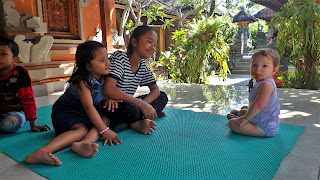


Arcata makes some friends while the adults take a cooking class. Local food, by the way, is pretty awesome in the areas we visited - one of many reasons we hope to return to Indonesia some day.


Roadside stop for a durian snack.


                   Ben and Cata go for a hike through the countryside.


Obviously it is bad form to take photos with a fogged up camera lens. 

In Indonesia, local homes and tourists rentals alike incorporate the outdoors into living spaces. 
In many cases, only the sleeping area is completely closed off. 

A truly enjoyable part of travel here is cooking, eating, and relaxing while taking in the flora and fauna; electrical storms and in this case, the smoking volcano behind Kristi. 

We did notice the pleasant open spaces were not always the most baby safe spaces. Unprotected balconies, insects, and in one case a pit viper were worrying at times.


The Gili Islands a shortish boat trip from eastern Bali when the seas are calm and even closer to the large Indonesian island of Lombok.


These islands are small; horse carts and bicycles are the only way to get around on land. The Gilis are a popular tourist destination, although we hit Gili Air during the low season and found it to be pretty sleepy. A lot of people come here to party, but it is also a great place to dive, enjoy the beach, and cruise around on a bike.

                                          Horned Seastar


Lobster peering out of it's hidey-hole and a little tridacna clam.


                                              Daytime Moray

Coral seems to be in pretty rough shape just about everywhere we go. We saw a decent amount of live coral snorkeling from the beach and some nicer coral gardens on the days we paid to go diving.

                                         Spanish Dancer eggs

Dive Time

Cata wrangles a beach kitty. This one had fleas, but was still seemed healthier then your average stray Kuwaiti cat.


Kristi made a rookie mistake on our first day at the island. This awesome pattern is still vaguely visible on her back 10 months later.


Thursday, December 19, 2019

The Hashemite Kingdom of Jordan


A few weeks ago we returned from a quick trip to Jordan.                         

Time and toddler limitations put some restrictions on what we were able to do.          
Jordan has many options for outdoorsy travelers. We opted to visit the city of Petra and the Dead Sea.


Eating good food is one of the things we love about living in the Middle East. A selection of Mezzes, like the one above, is never a bad snack choice. Cata also indulged in one of her favorite things - eating any kind of food.


 Scarves for sale in Petra and olives growing around the city buildings.

Ancient Petra lies in a canyon below modern Petra which exists mainly to cater to tourists. Petra was the center of the Nabatean civilization which dates to 300 BCE. Many tombs and temples are carved into the sandstone.


Kristi and Cata pose by an old olive press.

The drive from Petra over the Jordanian Highlands was especially scenic.


The Dead Sea is the lowest point on Earth (about 430 meters below sea level) and is really a lake with no natural outlet. The fine silt that accumulates is thought to remedy all manner of aliments. Most impressively, the high salinity makes if possible to float effortlessly on the surface.